Before hiring a blog writer, separate the article from the publishing work
A business can receive a well-written article and still have nothing ready for readers. The missing work may be a product fact awaiting approval, a page without an illustration or a publishing task that nobody accepted. When you hire help with business content, define the finished result before comparing prices. This guide uses hypothetical buying situations to explain the decisions; it does not report campaign results, supplier quotations or promised traffic.
Describe the result you are buying
Start with a sentence that explains what must exist when the work is complete. A draft in a document, an approved article in your content system and a checked public page are different results. Each can be a sensible purchase. Problems arise when the buyer expects one and the provider prices another. Write the result in everyday language, including where you expect to find it and who will use it.
For a hypothetical local service business, the immediate need might be a clear answer to a question customers ask before requesting an estimate. The result could be an approved draft for an employee to publish. Another business might need that answer published and announced through agreed channels. Neither arrangement is automatically superior. The useful question is which responsibilities your own team can reliably finish.
Check the facts that only your business can supply
A writer can organise an explanation, but cannot safely invent your delivery area, returns terms, service limits or product performance. List the facts that need an internal source and name the person who can confirm them. Give that person a reasonable review window. This makes the brief more useful than a collection of preferred adjectives and prevents a factual decision from becoming an endless debate about wording.
Separate a fact needing confirmation from a stylistic preference. Whether a service includes installation is a scope fact. Whether the introduction starts with an example is an editorial choice. If the fact is unresolved, decide what evidence is missing and who will obtain it. Paying for a longer article does not resolve an unanswered business question, and a confident sentence does not turn an assumption into evidence.
Name the owner of each publishing task
After writing, someone must prepare headings, select an appropriate illustration, set page metadata and check links. Someone must also have permission to publish. These tasks may belong to one provider or several people. Put names or roles beside them before work starts. A shared task with no owner is especially likely to be mistaken for work included in somebody else's quote.
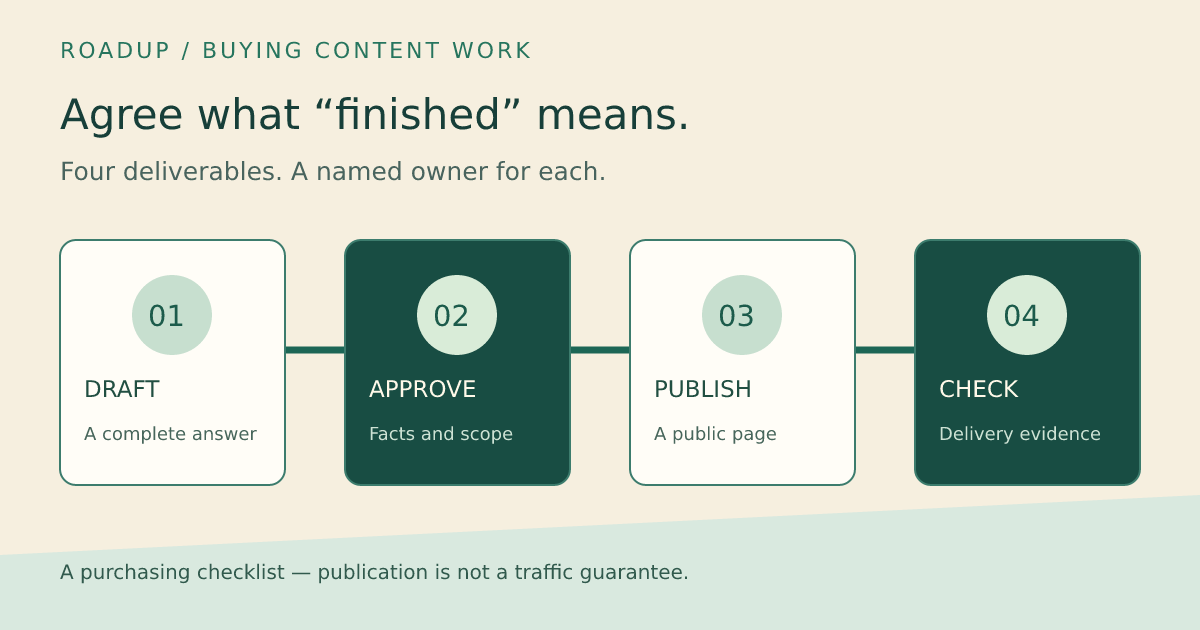
Use a small responsibility table with four columns: draft, approval, publication and verification. Under each, describe the deliverable and the person who accepts it. Verification might mean opening the public page and checking that the complete text, intended picture and useful links are present. That is a concrete acceptance check. It is different from promising that a search engine will index the page or that readers will arrive.
Compare like-for-like proposals
A low writing price may cover a useful draft and nothing else. A broader proposal may include research, an agreed revision round, publishing and a delivery report. Compare the included work before treating the difference as an indication of quality. Ask what the provider needs from you, what is excluded and what happens if required source material arrives late. These answers reveal more about the arrangement than a headline word count.
Do not expand a small initial brief into an entire content programme without revisiting the scope. If you decide that the article also needs a second language, a different illustration and several platform-specific introductions, record those as additional deliverables. The aim is a clear agreement that both sides can fulfil, rather than a deceptively small price that depends on unspoken work later. No example here is a suggested supplier tariff.
Give revisions a decision rule
Decide which changes count as corrections and which change the assignment. Correcting an unsupported claim or a broken source link is different from replacing the subject after a draft has been approved. State how feedback will be collected and who makes the final editorial decision. One consolidated response is usually easier to act on than separate contradictory comments from people who have not seen each other's notes.
Ask the reviewer to explain the reason for a requested change. A customer question that the article has not answered is a useful reason. A missing limitation supported by your service terms is another. An unexplained instruction to make the copy more premium gives the writer little to test. Keep revision decisions tied to the intended reader, verified information and the result agreed at the start.
Treat distribution as an agreed next step
Publishing on your website and introducing an article elsewhere are separate activities. If distribution is included, name the destinations and the kind of material to be prepared for each. A short contextual announcement may be appropriate in one place, while another requires a substantial original contribution. Do not assume that placing the same complete text everywhere makes each placement useful to its readers.
Agree what delivery evidence will be available. A public URL and a check of the resulting page can establish that something was published. Visits require actual measurement, and an enquiry requires an identifiable customer action. Keep these results separate in the report. This lets you judge delivery fairly without accepting either an unsupported traffic promise or a vague statement that a campaign was successful.
Choose a first assignment you can assess
A first article can be a manageable way to test how a provider handles facts, feedback and publication. Choose a question with a clear intended reader and source material your business can supply. Agree the acceptance checks before work begins, then review the actual result against them. A smaller, assessable assignment can expose missing responsibilities before they are repeated across a larger calendar.
RoadUp's published method describes a project moving through page selection, an agreed scope and confirmed price, managed publishing and checks of the resulting placements. Read the actual method at https://roadup.net/method when deciding which parts of the workflow you want help with. Confirm your own deliverables before ordering. A completed publication can be verified; rankings, indexing, visits and sales remain separate outcomes that need their own evidence.